The hail data you kept that other subscription for.
Roofing, exterior and restoration companies pay for canvassing software just to see the hail map inside it. This is the data underneath: the federal storm record, by street address. Dated, measured and cited, so it sends your crews to the right streets, wins trust at the door, and gives the carrier a source it can go and check.
The storm just wrote your lead list.
Spotters measure, radar tracks the cell, warnings go up. By morning, every street the storm crossed has a paper trail: sizes, times, positions, record numbers. The week below is how a company turns that trail into work.
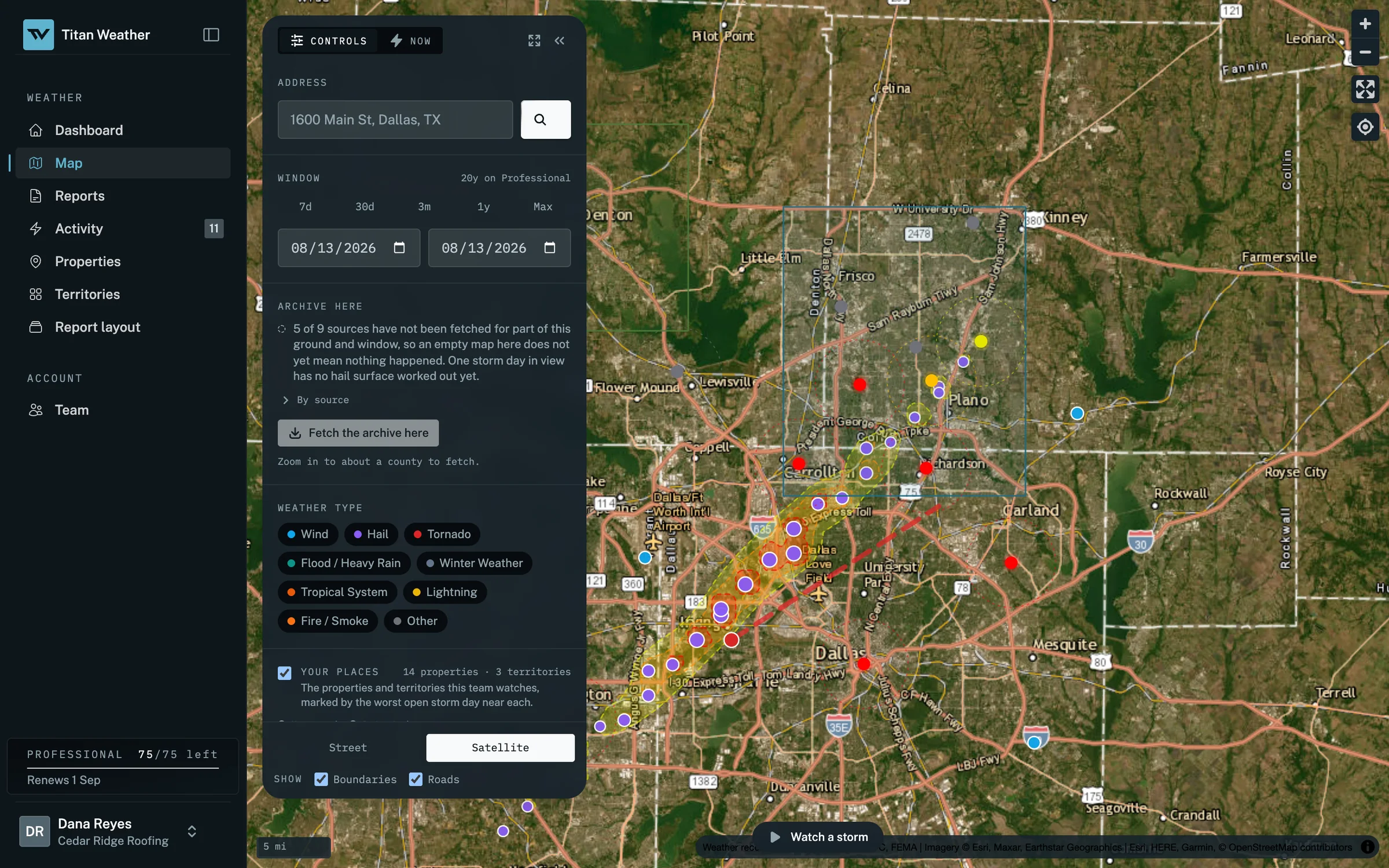
Hail maps are everywhere. Citations are not. The shaded blob in your canvassing software cannot tell a homeowner how you know, and it names nothing a carrier can go and look up. Every mark here traces back to a federal record number, so when somebody asks how you know, you can show them where it is written down.
The map is also honest about what it knows. The estimated surface looks like an estimate. A measured stone looks like a measurement. You always know which one you are betting a crew's day on.
Draw your service area once. The logging is automatic. A territory can be the shape you run crews in, a drive around a supply yard, or a set of named towns. It holds every storm day inside it for the last 90 days, every record observed or detected, and the warnings that were in force over it.
Warnings stay on their own line, apart from what actually fell. What was forecast and what hit the ground are two different things, and you only want to pay a crew to chase the second one.
Send crews where the hail actually fell.
- Stop canvassing on rumor
- A morning of door knocking costs real payroll. The board shows the estimated surface and the measured stones drawn apart, so you commit crews to streets the record actually reached, not streets somebody heard about.
- Your best leads surface first
- Every watched property is marked by the largest hail measured near it. The book reads at a glance: which roofs were under it, which were not, and which deserve the first truck.
- From map to report in one click
- One credit opens a new address for good; an address you have already opened runs free. After a big night, run every open storm day at once and start assigning.
Third knock of the morning. First one with the record.
By the time you knock, two companies already have. Everyone said the same thing: big storm, bad roof. The homeowner cannot tell the professionals from the chasers, and that confusion costs you jobs you should have won.
Open the record instead. Hail measured at a size, on a date, a stated distance from this roof, reported by a named federal system. Homeowners can look it up themselves, which is the difference between your word and a record. The free hail history by city pages make the same case before you ever knock, and they cost nothing to send.
- 21 Apr 2023
- 2.75″
- 0.8 mi NE
- Ground observation
- 21 Apr 2023
- 2.50″
- 1.4 mi N
- Storm record
- 11 Jun 2021
- 1.25″
- 2.6 mi SW
- Ground observation
Each line names the federal record it came from, so the homeowner can look any of them up before deciding who to trust with the roof.
A date of loss from memory is the easiest thing to argue with.
The homeowner remembers the loud storm in spring. The carrier checks that date against its own weather data before anything else. If the date does not hold, the claim stalls, and a job you already sold sits unpaid.
Run the address before you write the scope. The report names the storm, the date, the measured size and the distance from the roof, so the date you file is one you can point at a published record for. Before the report, the free roof exposure check counts the hail days near an address since the year the roof went on.
21 Apr 2023
Hail measured at 2.75″, 0.8 miles north-east of the property, filed as a ground observation.
- Source
- NOAA Storm Events
- Record
- 1087432
- Corroborated
- 3 further sources, same date
Six months on, the file still shows where the date came from.
Months later, a desk adjuster who never saw the roof reads the file. A radar screenshot gives them nothing they can check. A printout from a free weather site is the first thing questioned. What a reviewer can actually check is a document that shows its work.
The report states what was searched, over what area, and what it cannot settle. Every record cites its government source, and the fingerprint on each page shows the copy in the file is the one that was issued. We take no position on the claim; that neutrality is what keeps the document usable in it.
- NOAA Storm Events 3 records · Ground observation
- NCEI Storm Events Database: the finalized, quality-controlled federal record of storm reports, damage, injuries, and narratives compiled by NWS offices. Searched: Within 25 miles of the location, plus county/zone-level records covering its county https://www.ncei.noaa.gov/products/severe-weather/storm-events-database
- SPC Storm Reports 1 record · Ground observation
- Storm Prediction Center filtered storm reports: the national severe weather report log for hail, wind, and tornadoes. Compiled from reports as they arrive, and preliminary until NCEI publishes the finalized record. Searched: Within 25 miles of the location https://www.spc.noaa.gov/climo/reports/
Limitations
Distances are measured to the coordinates each source published for a record. Reports made from the ground are commonly filed against a town or a landmark rather than the spot where the measurement was taken.
Fingerprint 7f3a2b9e…c19d Issued 14 Mar 2026
A report is a record of what the public federal and volunteer archives hold for one address over one period, as the bodies that publish them released it. We compile and cite that record. We do not verify, correct or interpret it, and a report is not an inspection, a meteorological or engineering opinion, or legal advice. We take no position on any claim.
Your past customers are your next storm's best leads.
Every roof you have ever put on is a customer who already trusts you. When the next storm crosses one and nobody tells you, that job goes to whoever knocks first. Import the customer list once, from a CSV, tagged the way your office tags it, and every address is watched from the moment it is saved.
When new hail crosses a roof you put on, you hear first: email, signed webhook, and a digest each morning in your time zone. You already know the roof's age, the shingle and the homeowner's name. Be the first call, not the fourth knock.
2 of 5 watched addresses under the new storm day
Storm leads should not die over the weekend.
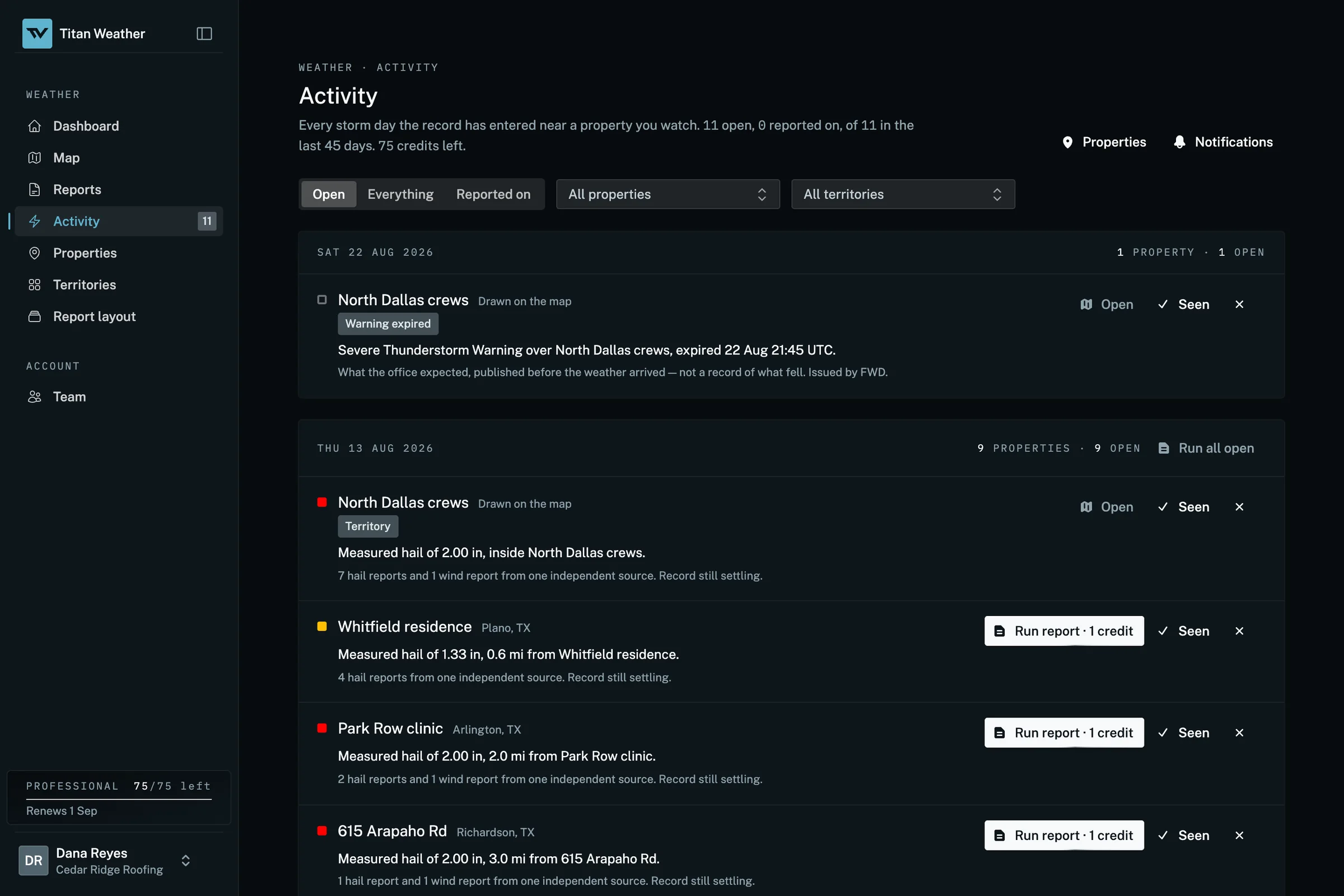
The morning after, the day's work is already a list: one row per storm day per place, with the hail measured, its size, and how far from the property it was taken. Mark it seen, hand it to a salesperson, or run the report straight from the row. Send it to your CRM by webhook without leaving the page.
A storm that hits on a Friday is not a lead that dies by Monday. The row stays open until someone on your team closes it.
Try it on a real address before anyone pays anything.
A credit opens an address for good: every report you run on it after that is free, which matters when a claim drags into a second season. The full plans, limits and history depths are on the pricing table.
Start free
$0
Your first 3 addresses, one report each. No card required: run the storm you are standing in before deciding anything.
Buy a pack
$19
3 addresses bought outright, about $6.33 a report, with 2 years of history. For the company that works a storm at a time.
Plans from
$39a month
15 addresses a month, unlimited reports each, with 2 years of history and monitoring across your book and territories. Cancel whenever you like.
Asked by storm contractors before they rely on it.
What the report says and refuses to say, what monitoring actually watches, and what any of it costs. The longer answers are in the guides, and the smaller questions are answered by the free tools, no account needed.
How do roofing contractors get a hail report for an address?
Enter the property address. A few minutes later you have every hail, wind and tornado event on record at that address: each one dated, measured where a measurement was taken, placed by its distance from the roof, and cited to the government record it came from. It is issued as a page you can show at the kitchen table and a PDF that goes in the claim file.
Can I see where a hailstorm actually hit before I send crews?
Yes. Pick a storm day on the map and you see the hail surface estimated from radar, the measured ground reports on top of it, and the warnings that were in force, each drawn differently so an estimate never passes for a measurement. Draw your service territory once and every storm day inside it is logged against it from then on.
Can I get hail alerts for past customer addresses?
Import your customer list from a CSV and every address is watched from the moment it is saved. When something new lands in the record near one of them, you get an alert by email or signed webhook, a digest the next morning in your time zone, and a row in the activity list that stays open until someone on your team deals with it.
How do I find the date of loss for a roof?
Run the address before the date goes on the scope. The report lists every storm on record at the property in the period, so the date of loss is read off the record rather than recalled at the kitchen table. Before that, the free date of loss finder lists the storm days near any address, and the roof exposure check counts the hail days since the year the roof went on.
Will an insurance carrier accept a hail report from a contractor?
No one can promise how a particular reviewer or carrier will treat any document, and we will not pretend otherwise. What the report does is make every figure verifiable: each record names its federal source and identifier, and the method section states what was searched and over what area. Most disputes are not about whether the storm happened. They are about whether it can be shown.
Does the report say whether the roof is damaged?
No. The report documents what the weather did at the address; the inspection, the scope and the opinion are yours. We do not characterize damage or assign causation, and that neutrality is what lets the same document be read by you, the homeowner and the carrier without an argument about who wrote it.
Can my whole company work out of one account?
Accounts are team-based. Invite the office and everyone shares the same address book, territories, activity list and reports, tagged the way your office already tags them. Storm days can be sent to your CRM by webhook, and the API is there when you want the data inside your own tooling.
How much does storm data for contractors cost?
Your first 3 addresses are free, with no card required. Credits open addresses: one credit unlocks one address for good, and every report on an unlocked address after that is free. Reports are also sold in one-off packs, and monthly plans carry deeper history, a wider search radius and monitoring for your whole book. Cancel whenever you like.
Run the address before the trucks roll.
Your first reports are free, on the storm you are working right now. If there is nothing on record at the address, the report says so just as plainly, which is worth knowing before anyone climbs a ladder.