How do I get a weather report for an insurance claim?
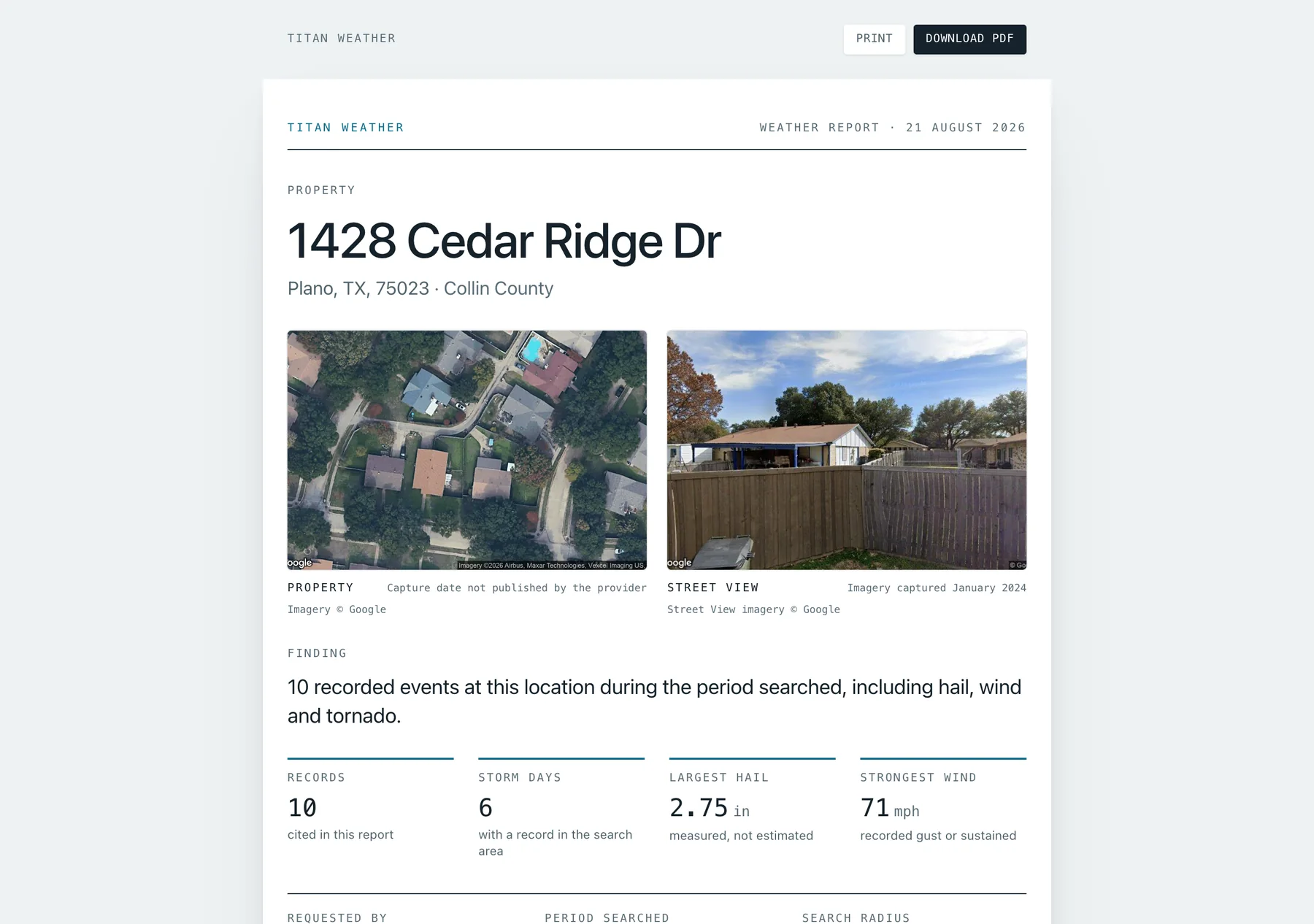
Enter the property address. The report compiles every hail, wind, tornado, flood, fire and lightning event on record at that address from the public federal weather record, dates each one, states its distance from the property, and cites the record it came from. It is issued as a page you can read and a PDF you can attach to the claim file, with the method and the sources searched printed on the document itself.
Can I get a hail report by address?
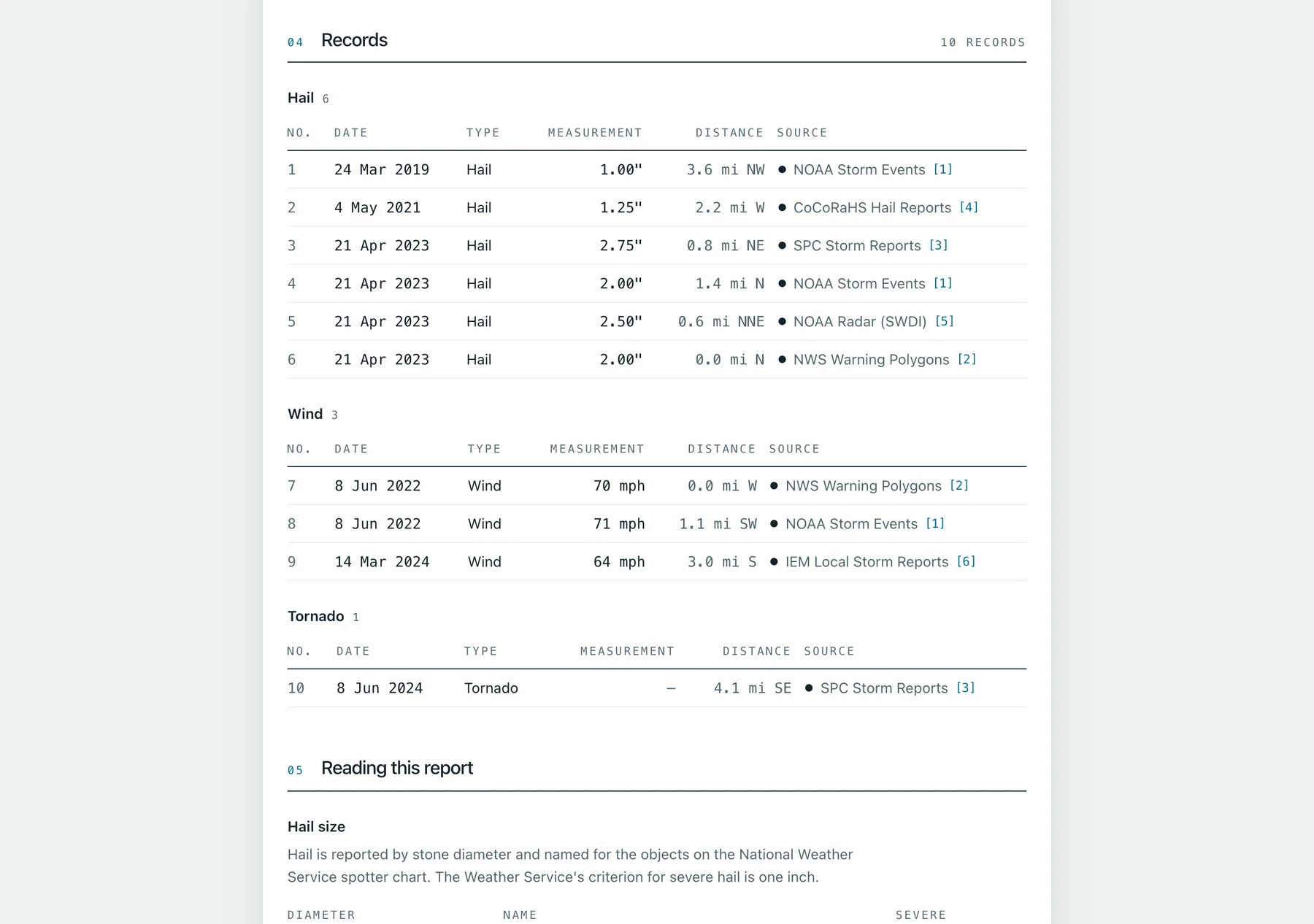
Yes. Every report is compiled for one street address rather than a county or a ZIP code. Hail arrives from ground reports relayed by Weather Service offices, the finalized storm record, radar detection and the warnings that were in force, each with its reported size where one was taken and its distance and bearing from the property. The same report carries the wind, tornado and flood record for the address, so a hail report by address and a wind report by address are the same document.
What is a date of loss weather report?
A report that tests a stated date of loss against the record, or finds the date when nobody is sure of it. It lists every storm on record at the address in the period, so the day the damage occurred can be read off the record rather than recalled. Where the stated date does not match anything on record, the report says so, which is as useful to a claim as a match.
How far back does the historical weather record go?
The finalized federal storm record runs from 1996, and that is the deepest a report reaches. It is not equally deep throughout. Reporting density, radar coverage and the detail kept against each entry all thin as the years go back, and hourly wind detail coarsens faster than storm reports do, so a quiet stretch early in a long window may describe who was observing rather than what the weather did. Every report states the period it covered and says this on the document. Your plan sets how much of the depth a report may use.
Who uses a property weather report?
Contractors, public adjusters, independent adjusters, attorneys, meteorologists, engineers and building consultants. The common thread is a professional opinion that has to be documented: what the weather did at a specific address, on a specific date, and where that is written down. Property owners order them too, though most of our volume comes from licensed practitioners working a file.
Do you interpret the data or offer an opinion?
No. We compile and document the record; the professional opinion is yours. Every observation arrives with its source, record identifier, observation time, distance, bearing and evidence kind intact, which is what an analysis needs to rest on. We do not characterize damage, assign causation or take a position on a claim.
What if there is nothing on record for the address?
You get a report that says so, listing every source searched and the period covered. That is a substantive result rather than a failed one. It settles the question when a loss is attributed to a storm that did not reach the property, and it is worth having before any further work is scoped.
Will an insurance carrier accept a weather report from a third party?
No one can promise how a particular reviewer, carrier or court will treat any document, and we will not pretend otherwise. What we can do is make every figure verifiable: each record names its source and identifier, and the method section states what was searched and over what area. Most disputes are not about whether the weather happened. They are about whether it can be shown.
Does a report include every storm that hit the property?
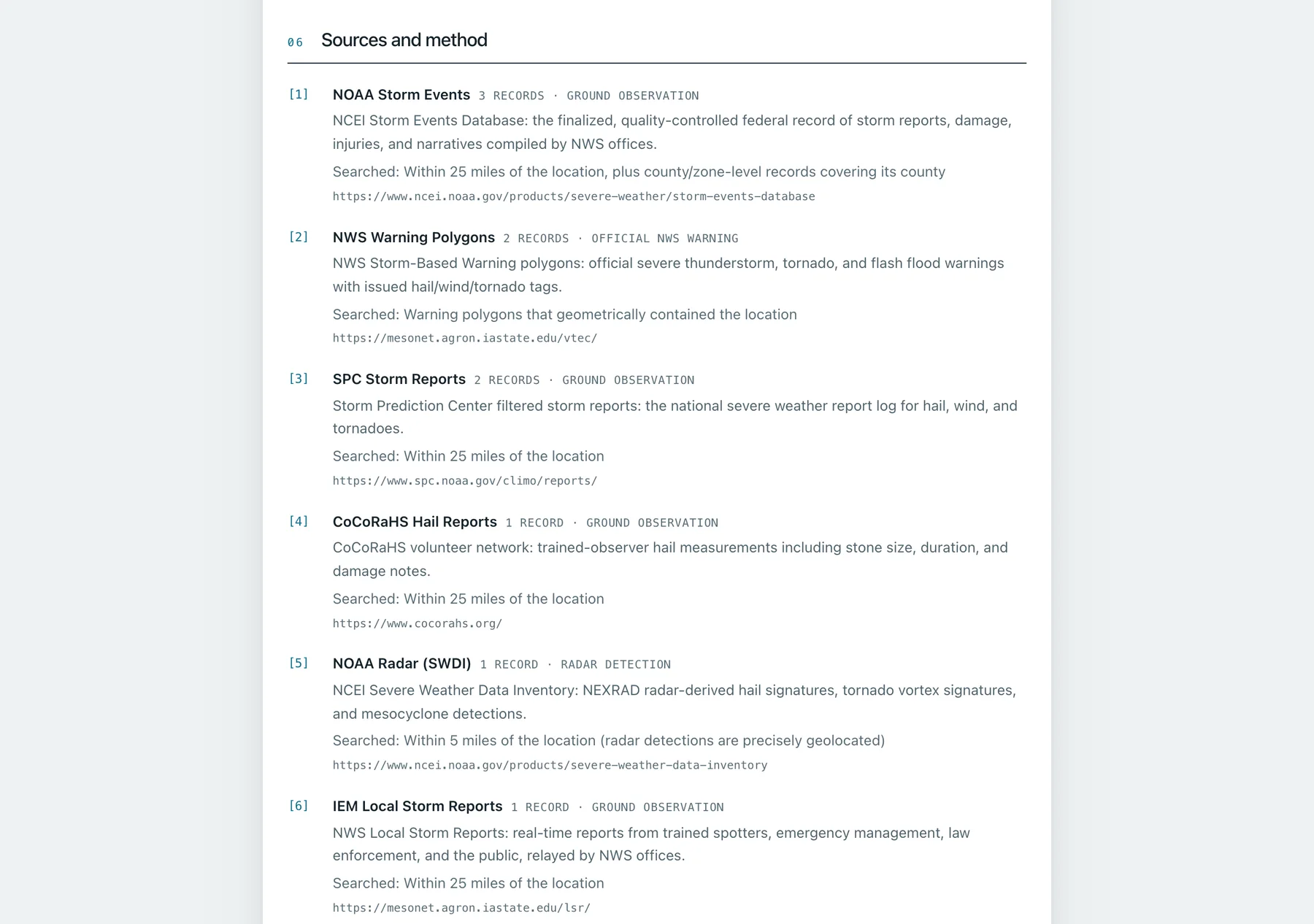
It includes every event the sources we searched hold for that address over that period, and it names those sources and the area each was searched at. That is not the same as every storm that occurred. Severe weather is only on the record if something or someone caught it: a storm can cross ground nobody reported from, an instrument can miss a gust between readings, and a report can be filed weeks later or revised years later. Radar, warnings and gridded analysis cover ground no witness stood on, which is why every report searches those too, but no archive holds everything and we do not claim otherwise. A report says what it searched so a reader can see the shape of what it could and could not see.
How accurate is the location of a hail or wind report?
A distance is measured to the coordinate the source filed, and that coordinate belongs to the source rather than to us. Reports made from the ground are commonly logged against a town, a landmark or a stated offset from one rather than the spot where the measurement was taken, and the gap between the two can run to several miles. Radar detections and warning polygons are instrument-located and do not carry that offset. The report states this, and it is the reason a day carried by several kinds of evidence is worth more than a single reported point.
Is the wind speed measured at my property?
Almost never, and the report says so. Measured wind comes from official stations, which may be some miles off, and the distance is printed beside it. Anything worked onto a grid is labelled analyzed rather than measured, because it describes an area the address sits in rather than the address itself. That distinction is what makes these reports usable in technical work, and we hold to it.
How long does a weather report take?
Usually a few minutes. An address nobody has asked about before takes longer, because we retrieve the archive rather than serving something stale. There is no need to sit and watch it either. Once the report is ready, the PDF is rendered in under a minute. Run a batch, carry on with the day, and they are in your list when you come back.
Which areas does a weather report by address cover?
The United States, including territories covered by the National Weather Service. Coverage is only as good as the underlying federal record, which is denser in populated areas, since a hail report requires somebody to have reported it. Radar, warnings and gridded analysis do not depend on a witness, which is part of why every report searches all of them.